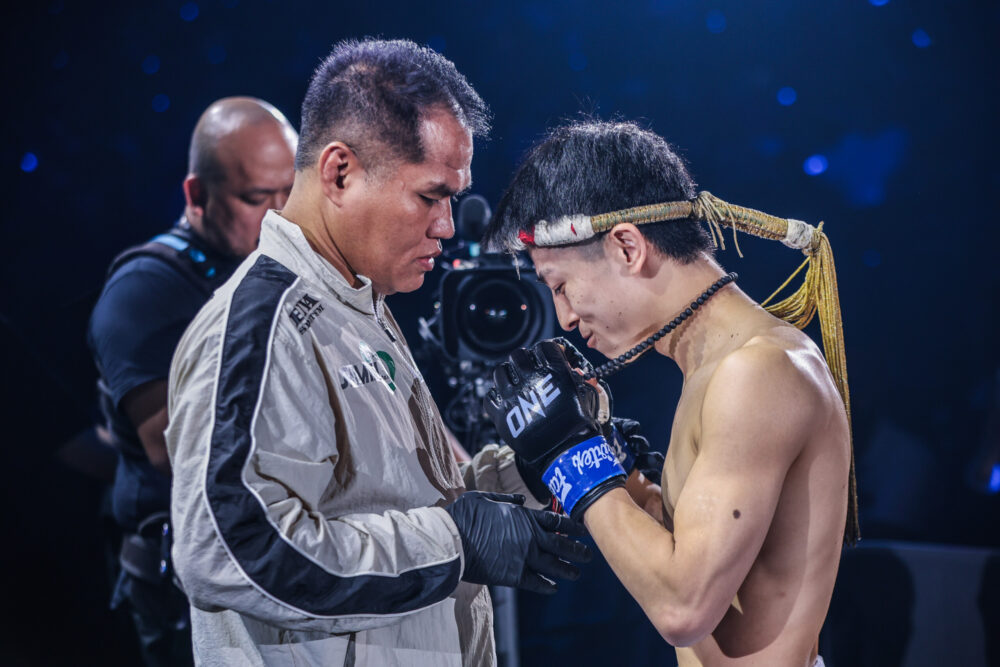
Most fighters spend their careers chasing stadium glory. Nadaka Yoshinari collected it like currency on his way to something bigger.
The 24-year-old Japanese sensation has been named ONE Championship’s 2025 Muay Thai Fighter of the Year, capping a remarkable 12-month run that saw him extend his winning streak to 40 consecutive victories and capture the inaugural ONE Atomweight Muay Thai World Championship on home soil at Tokyo’s Ariake Arena in November.
But to understand why Nadaka stands alone among non-Thai fighters, you have to understand the venues that forged him — and the significance of the stages where he built his legend.
Bangkok’s Stamp Of Approval
At 14 years old, most teenagers are worried about homework and fitting in. Nadaka made his professional debut at Lumpinee Stadium, defeating Phansaeng Sakwarun by decision in 2015. It wasn’t just a fight. It was a statement — a Japanese kid walking into one of the top Muay Thai stadiums and announcing he belonged.
That early Lumpinee appearance was just the beginning. Over the next several years, Nadaka systematically conquered Bangkok’s elite stadium circuit in a way no foreign fighter had done before. He became the only non-Thai in history to win three Rajadamnern Stadium Muay Thai titles across three different weight classes, capturing belts at pinweight, mini-flyweight, and light flyweight.
In December 2018, Nadaka challenged Hercules Phetsimean — the unified Rajadamnern and Lumpinee mini-flyweight champion — for his Rajadamnern title. Fighting at one of Thailand’s most revered venues, the 17-year-old Japanese prodigy won by unanimous decision after five rounds, claiming his first Rajadamnern belt and signaling his arrival among the sport’s elite.
Four months later in April 2019, Nadaka returned to Lumpinee Stadium to face Singdum Kafaefogus for the vacant Lumpinee mini-flyweight championship. Again, he emerged victorious by unanimous decision after five rounds, simultaneously holding Rajadamnern, Lumpinee, and IBF Muaythai titles — an unprecedented achievement for a foreign fighter barely into adulthood.
These weren’t ceremonial belts handed out at promotional events. These were titles earned in Thailand’s most prestigious venues, judged by Thai officials, watched by Thai crowds who’ve seen every style and seen through every pretender. The stadiums that have defined Muay Thai hierarchy for generations looked at Nadaka and said: This one belongs.
Why Stadium Pedigree Matters
In Muay Thai, venue credentials aren’t just resume padding — they’re the sport’s measuring stick. Winning at Rajadamnern or Lumpinee proves you can perform under the sport’s most demanding conditions: traditional scoring that favors technical mastery, educated crowds, and judges who are sometimes swayed by corruption.
Nadaka didn’t just win at these venues. He dominated. His southpaw technical precision, developed under the tutelage of Khundong Por Thawatchai at Eiwa Sports Gym in Yokohama, translated seamlessly to Bangkok’s exacting standards. The karate foundation he built starting at age 4 gave him explosive kicks and footwork. The 95 amateur bouts before turning pro at 14 built his ring IQ.
But it was his willingness to fight Thailand’s best in Thailand’s most prestigious rings that separated him from other talented foreigners. By the time he signed with ONE Championship in early 2025, Nadaka had already built a resume that most fighters would retire satisfied with — 10 titles across multiple organizations, three-division Rajadamnern champion, Lumpinee titleholder, WBC and WMC gold.
The Bangkok stadium circuit had given him its blessing. Now ONE Championship would give him a global stage.
Conquering The Global Stage
Nadaka’s promotional debut at ONE 172 in March 2025 came at Saitama Super Arena — not Thailand, but Japan. Against former Lumpinee kingpin Rak Erawan, the hometown crowd watched Nadaka deliver a striking masterclass for three rounds before sending the Thai crashing to the canvas with a straight left just 20 seconds before the final bell.
The message was clear: The stadium education translated globally.
Three months later at ONE Friday Fights 114 at Lumpinee Stadium in Bangkok, Nadaka faced Banluelok Sitwatcharachai, a knockout machine with a pristine 3-0 ONE record. Fighting at the venue where he’d made his pro debut a decade earlier, Nadaka’s movement was pure artistry — feints that froze opponents mid-attack, footwork that created distance when pressure came, counters that landed with surgical precision. He earned a unanimous decision, proving his technical mastery worked against fellow finishers.
In August at ONE Friday Fights 124, still at Lumpinee, Nadaka faced Morocco’s Hamada Azmani. After two competitive rounds, he unleashed a combination that crumpled Azmani to the canvas 15 seconds into the third round, right there at Lumpinee, reminding everyone why Bangkok’s stadium circuit had anointed him years earlier.
The Homecoming
But the defining moment of Nadaka’s 2025 came on November 16 at ONE 173 inside Tokyo’s Ariake Arena. Against Thailand’s Numsurin Chor Ketwina, a veteran with over 100 career victories and a perfect 6-0 ONE record, Nadaka fought for the inaugural ONE Atomweight Muay Thai World Championship in front of his home country.
For five rounds, he controlled the narrative with the same surgical precision that had earned him Rajadamnern and Lumpinee gold years earlier. His feints lured Numsurin forward. His counters landed with increasing regularity. His movement frustrated every adjustment the Thai veteran attempted.
When the final bell sounded, all three judges scored the contest in Nadaka’s favor. He claimed the division’s inaugural crown, extended his winning streak to 40 consecutive victories spanning six years, and became Japan’s first ONE Championship Muay Thai World Champion.
The venue mattered. Just as Lumpinee and Rajadamnern had validated his greatness in Thailand, Ariake Arena watched him bring that Bangkok-forged excellence home to Japan. The journey from a 14-year-old debuting at Lumpinee to a 24-year-old ONE champion crowned in Tokyo wasn’t just about collecting belts. It was about proving that stadium pedigree transcends geography.
Nadaka now holds 11 world titles across five weight divisions. He’s the only foreign fighter to win three Rajadamnern Stadium belts and just the second non-Thai (after Youssef Boughanem) to hold both Lumpinee and Rajadamnern titles simultaneously. His 2025 produced four spectacular victories across three venues — Saitama, Lumpinee, and Tokyo — each performance adding another chapter to a career defined by the stages where he’s performed.
ONE Championship’s 2025 Muay Thai Fighter of the Year award isn’t just recognition for a great year. It’s acknowledgment that Nadaka did what few foreign fighters ever manage: He earned Bangkok’s respect at Rajadamnern and Lumpinee, then carried that stadium-forged greatness to the global stage and brought championship gold back to Japan.
The venues tell the story. And Nadaka’s story runs through the most prestigious rings in Muay Thai history.
