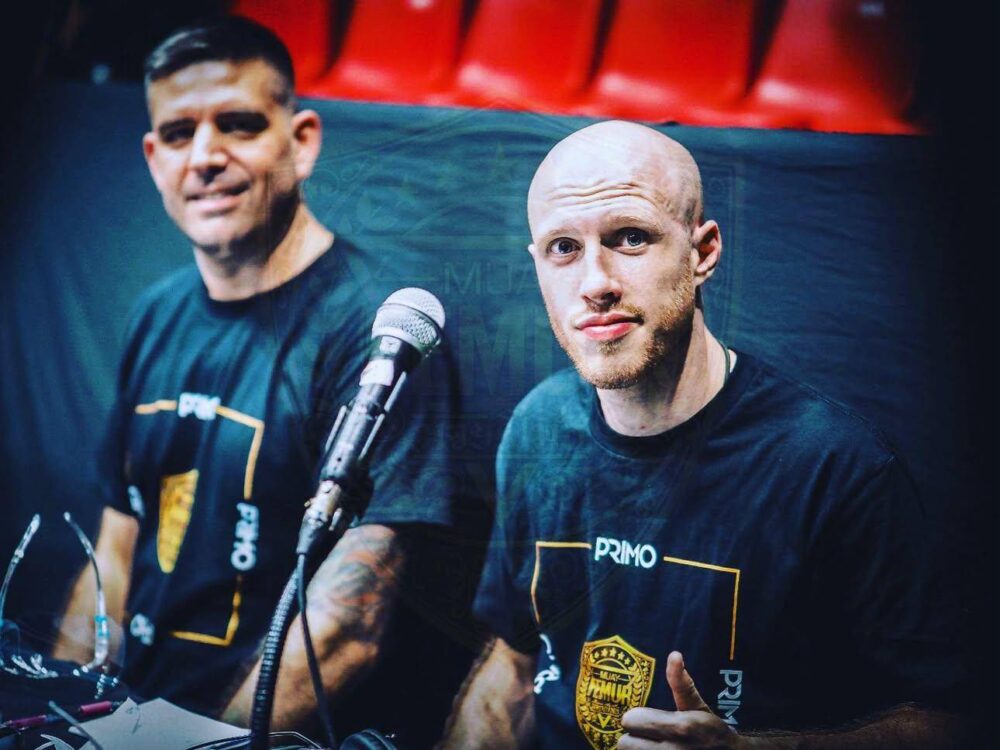
My goal with MuayThaiStadiums.com is to bring you insider info that you won’t find on any other blog, social media account, or AI chat bot. So I’ve decided to open the floor to a few of my commentator friends to let them share their experiences with you. This way, you get more than just my perspective on watching Muay Thai in Thailand.
In the first post in this series, I talk to Ali McOnie, a long-time English-language commentator who I’ve worked with at Lumpinee Stadium, Siam Boxing Stadium (Omnoi), and more.
Ali suggests which stadium and event to watch Muay Thai in Bangkok, where he would sit, and what he looks for when watching Muay Thai fights in Thailand to better understand what’s happening in the ring.
How did you get started in commentating Muay Thai fights? What year?
I started commentating in 2019. I filled in last minute as an English commentator at Channel 7 Stadium, calling the fights alongside Jay Tonkin. Wanchalong PK Saenchai headlined the card.
A first-timer can only attend one event this trip. Which stadium, which night of the week, and why that specific combination?
I’d say either go to ONE Lumpinee on a Friday night at Lumpinee Stadium or RWS at Rajadamnern Stadium on a Saturday. ONE Lumpinee has a variety of combat sports; the show is very fast-paced and exciting. RWS not only has good Muay Thai, but the stadium also has activities during the event that the audience can enjoy in between fights. There’s open scoring so a “first-timer” can get an idea of which fighter is winning during the fight.
Where do you personally sit when you’re watching for pleasure, not working — and what do tourists get wrong when picking seats?
I try to sit in the stands so that I have a central view. I think sitting ringside is great, but I think you get the real experience and atmosphere sitting with the crowd, especially if some of the fighters’ fans are sitting near you.
What’s the one moment in an event that casual visitors most often miss, leave early for, or don’t realize they should be watching?
This is a tricky question to answer. I’d say watching the corners during the fight or in between rounds, because you get a glimpse of what you can expect next in the following round.
What do the gamblers around you know that the tourists don’t?
The gamblers know the fighters, the sport, and the rules inside out. They can tell instantly if a fighter is not in shape and how to advise a fighter they’re betting on to beat their opponent from their depth of experience and knowledge of the sport.
What should a visitor eat or drink at the stadium — and what should they skip?
Stadium food in Thailand can be hit and miss. If you want to buy food at a stadium, I’d buy food that’s cooked fresh in front of you.
What’s the most common thing you see foreign visitors do that makes locals cringe — and what’s the easiest way to avoid it?
Back in 2024, when I was cornering my Canadian friend at a Wednesday night show at Rajadamnern, he was performing a longer wai kru — the ritual dance before a Muay Thai fight — than his Thai opponent. An American in the crowd started shouting abusive comments at him because of this. I’m using this story as a warning because foreign visitors must respect Thai culture; respect is ingrained in it, and the wai kru is a big part of that.
How can someone who knows nothing about Muay Thai tell whether they’re watching a good fight?
Listen to the crowd. If the crowd is going nuts (foreigners and Thais), then you know the fight is good. The atmosphere is usually the best part of the stadium experience.
What’s changed about the stadium experience in the last five years that visitors relying on old blog posts or guidebooks would get wrong?
Visitors now are so lucky because there are more three-round Muay Thai fights available that offer fast-paced Muay Thai. This has created a surge of interest in the sport and brought a lot of new fans to it. But there are still five-round Muay Thai fights, which revolve heavily around the gambling going on outside of the ring, and the scoring is complex. Muay Thai bouts are scored on a variety of things compared to Western boxing and MMA. Even though this is authentic, some foreign visitors might become confused about why a fighter in a five-round fight lost a bout.
Describe your perfect fight-night routine from arrival to leaving — where you eat before, when you show up, how you get home.
It varies depending on which stadium I’m going to and what day of the week it is. I usually eat at home, or if I’m going with a large group of friends, we’ll meet at the stadium to eat before the fights and start drinking. I always try to get to the stadium early because travelling around Bangkok is difficult with the heavy traffic. To counter this, I either drive, get a motorbike taxi, or use the sky train or subway.
What’s one memory from a stadium that captures why this sport matters to you?
There are so many to mention. I remember when I first came to Thailand in 2010, watching Saenchai and Pornsanae fight at the old Lumpinee Stadium. The atmosphere was electric. And on the same trip, when I was training at Kiatphontip Gym, one of their fighters, Samsamut, defended his Rajadamnern and Thailand titles at Rajadamnern Stadium. Rajadamnern was packed to the rafters with gamblers.
For a first-timer like myself, I was blown away by how crazy the crowd was. Fast forward to this era of Muay Thai, I can honestly say I’ve had some amazing moments at all the stadiums in Thailand, from watching Superlek versus Rodtang, Daniel Rodriguez versus Yodwicha, and fights at very authentic Thai stadiums like Jitmuangnon, Channel 7, and Siam Boxing Stadium (Omnoi).
